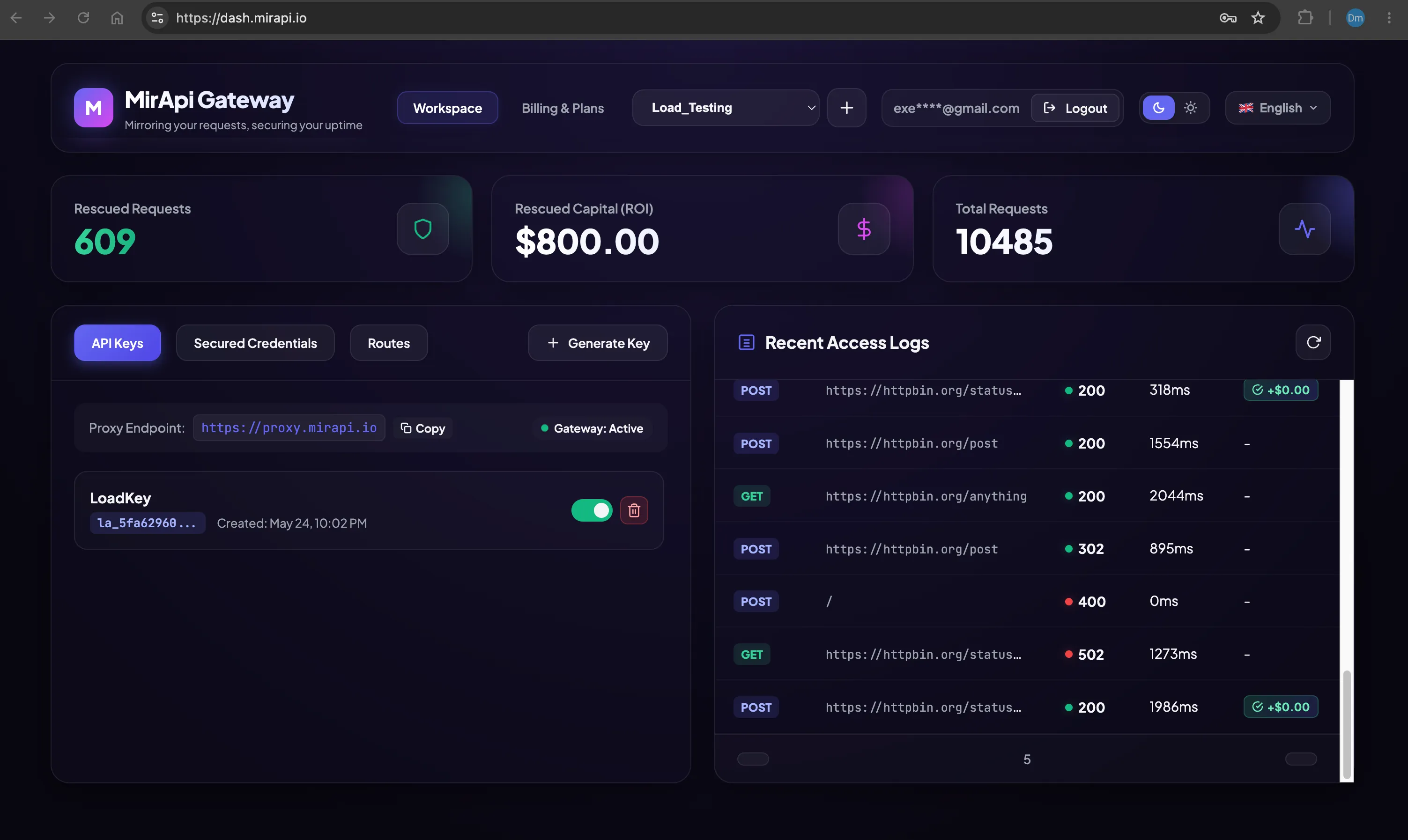
ROI Analytics & Rescued Capital
MirApi Gateway provides detailed analytics showing the exact value and return on investment (ROI) it delivers to your application. Instead of showing abstract uptime percentages, the gateway tracks concrete performance metrics including Rescued Requests and Rescued Capital.
What is a “Rescued Request”?
Section titled “What is a “Rescued Request”?”A request is classified as rescued if it initially failed (due to upstream outages, connection timeouts, or rate limits) but ultimately succeeded because the gateway intervened using one of its resilience modules.
The gateway increments the rescued count when:
- Retries Succeeded: The primary call failed, but a subsequent retry attempt (
X-Retry-Count) succeeded. - Failover Resolved: The primary URL failed, but the request was saved by calling the
X-Failover-URL. - Smart Cache Served: The upstream failed, and the gateway served a fresh cached response (
X-Smart-Cache). - Cascade Fallback Completed: The primary target in a sequential cascade route failed, but a backup target resolved the request successfully.
Rescued responses contain the X-Rescued header diagnostic, indicating how the request was saved (cache, failover, or cascade_fallback).
Rescued Capital Tracking
Section titled “Rescued Capital Tracking”For e-commerce, banking, and payment applications, a failed API request represents lost revenue. The gateway automatically calculates the amount of transaction volume it protects.
How it works:
Section titled “How it works:”- Body Parsing & Extraction Rules:
- Recursive Search: The gateway recursively traverses the request’s JSON payload structure.
- Target Fields: It searches for the fields
amount,sum, andtotal(case-insensitive). - Priority Order: If multiple matching fields exist at the same level of the JSON hierarchy (e.g., both
totalandamount), the priority order for extraction is:amountsumtotal
- Supported Types: The value can be represented as
float64,string,int, orint64.
- Trigger: The extracted amount is credited to Rescued Capital only if the request is successfully rescued (the internal
rescuedflag becomestrue). This happens when the initial attempt to the primary upstream fails, but a success response is achieved via one of the gateway’s resilience mechanisms:- Smart Cache: Served successfully from the cache when the upstream returned a
5xxerror or was unreachable. - Retry Logic: Successfully completed after one or more automatic retry attempts (diagnostic header
X-Rescued: retryadded). - Failover Route: Rescued by redirecting to a backup
X-Failover-URL. - Cascade Route: Success achieved on a lower-priority or parallel backup host within a configured cascade target list.
- Smart Cache: Served successfully from the cache when the upstream returned a
- Aggregation: The saved capital is summed over monthly horizons.
Example Scenario:
- Your client app makes a payment request:
POST /v1/chargeswith body{"amount": 150.00, "currency": "usd"}. - The primary Stripe API returns
502 Bad Gateway. - MirApi Gateway intercepts the failure, retries the request after a short delay, and the second attempt succeeds.
- The user receives a success response. The gateway registers:
- Rescued Request:
+1 - Rescued Capital:
+$150.00
- Rescued Request:
Database Sync Architecture
Section titled “Database Sync Architecture”To ensure high throughput and prevent write locks under load, the gateway uses a buffered writing architecture:
- Metrics are first aggregated in Redis using atomic operations:
user:metrics:<id>:total_requestsuser:metrics:<id>:rescued_requestsuser:metrics:<id>:rescued_capital
- The user is flagged in the Redis set
users_metrics_to_sync. - A decoupled flusher worker (
StartMetricsFlusher) running in the background pops dirty users, aggregates Redis values, and commits them in batches to the PostgreSQLuser_metricsdatabase table every 10–30 seconds.
ROI Dashboard
Section titled “ROI Dashboard”These metrics are exposed in real-time in the client dashboard. Clients can see:
- Rescued Requests: Total number of transactions saved from failing.
- Rescued Capital: Total monetary value of transactions that would have failed without the gateway.
- Protection ROI: Graphic representation of saved pipelines vs. proxy subscription cost.